
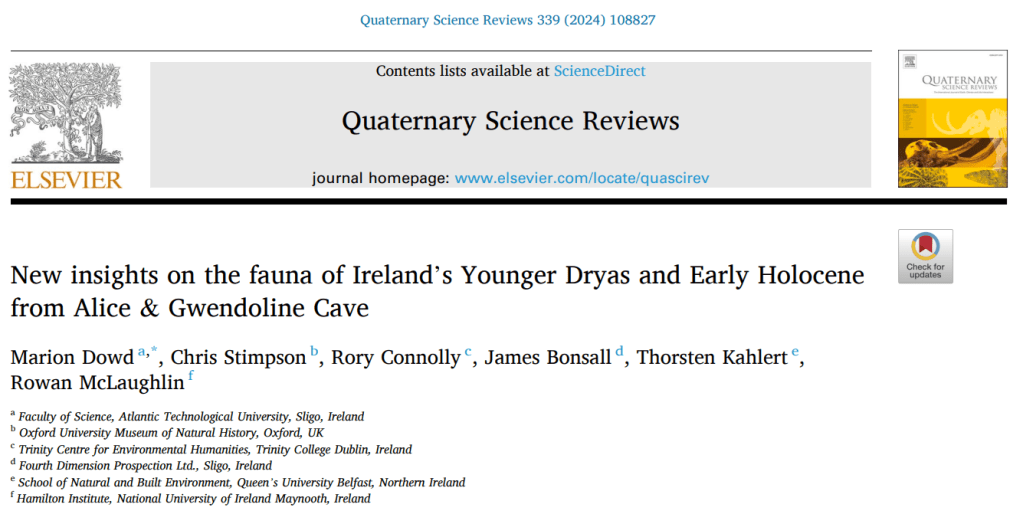
I am pleased to announce a new research article titled ‘New Insights on the Fauna of Ireland’s Younger Dryas and Early Holocene from Alice & Gwendoline Cave’, conducted with my colleagues Marion Dowd, Chris Stimpson, Rory Connolly, Thorsten Kahlert, and Rowan McLaughlin, sheds light on the faunal dynamics of Ireland during the Younger Dryas and Early Holocene. The article is published in Quaternary Science Reviews, Volume 339, and is open access.
Highlights
- New direct dates for brown bear, giant deer and reindeer
- Persistence of brown bear, giant deer and reindeer during first centuries of Younger Dryas
- First instance of sedimentary lipid analysis of Irish cave deposits
- Re-evaluation of the site with first evidence of Pleistocene human occupation of Ireland
Our research delves into the significant changes in Ireland’s fauna during the Younger Dryas and Early Holocene, as revealed through the extensive study of Alice & Gwendoline Cave, Co. Clare. By examining the data from this site, we provide new insights into the species that inhabited Ireland during these times and their responses to climatic shifts. This collaborative effort brings together expertise from various fields, resulting in a robust and multidisciplinary approach to our research.
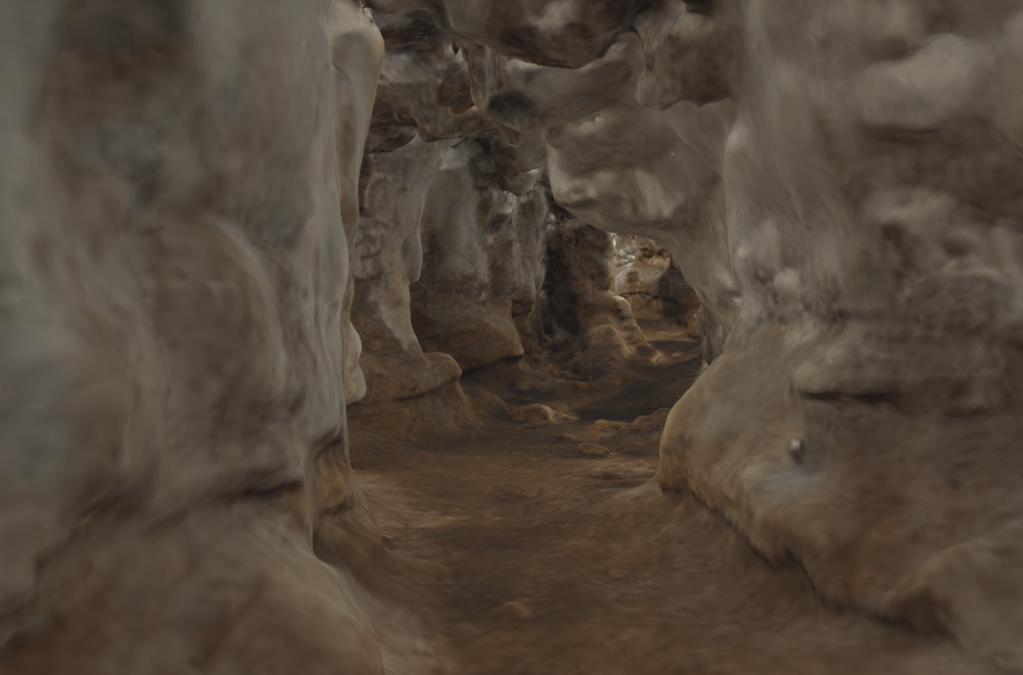
My contribution to this research focused on conducting geophysical surveys to characterize the surficial and underlying cave deposits, providing a basemap of potential archaeosediments. The cave interior and exterior were surveyed using high-resolution magnetometry and magnetic susceptibility to identify areas of burning. A metal detection survey was conducted in all passages and outside, to guide excavators toward the location of metal objects. Additionally, an earth resistance survey was employed to determine the presence or absence of disturbed soils or stony deposits. The main conclusions of the surveys are featured in the paper, and all of the results are linked as supplementary data. My colleague, Thorsten Kahlert, also produced a 3D model of Alice and Gwendoline Cave, so that anyone can virtually visit it.
Abstract
The nature of the mechanisms that have shaped the animal communities of the island of Ireland remains a pervasive question in the study of the Quaternary of north-western Europe. Archived Quaternary faunal bone assemblages from antiquarian excavations of cave sites are a direct line of evidence with demonstrable potential to shed light on this issue, but are currently constrained by limited publication, understanding of early excavation protocols, and a lack of chronological reference. Alice and Gwendoline Cave in the west of Ireland was the subject of extensive excavations in 1902, which yielded a substantial faunal assemblage and the first evidence of an Upper Palaeolithic human presence on the island during the terminal Pleistocene. Here, we report further results from this important site. Archaeological excavations and a radiocarbon dating programme in 2019-2020 have shed light on the environmental context of the faunal assemblage, the cave taphonomy and site chronology. Nineteen radiocarbon dates are now available, including new direct dates for brown bear (Ursus arctos), giant deer (Megaloceros giganteus), and reindeer (Rangifer tarandus). The archaeological excavations and the analysis of sedimentary lipids – the first of its kind for an Irish cave site – both suggest that the sediments are primarily of exogenous origin, likely carried into the cave through fissures and openings by runoff or colluvial movements. Our analyses indicate that there were at least three main ‘pulses’ of bone-bearing sediment accumulation: at the beginning of the Younger Dryas (c. 12,700 cal. BP), in the aftermath of the Younger Dryas (11,300 cal. BP), and in the Early Holocene (c. 10,000 cal. BP), with a hiatus in sediment deposition after 9700 cal. BP.
Access the Full Article
You can read the full article here: New Insights on the Fauna of Ireland’s Younger Dryas and Early Holocene from Alice & Gwendoline Cave. This open access publication ensures that our research is freely available to all interested readers.
Full publication details:
Dowd, M., Stimpson, C., Connolly, R., Bonsall, J., Kahlert, T., and McLaughlin, R. (2024) ‘New insights on the fauna of Ireland’s Younger Dryas and Early Holocene from Alice & Gwendoline Cave’, Quaternary Science Reviews, 339, doi: 10.1016/j.quascirev.2024.108827.

 Dr James Bonsall